

Lots of food is wasted nationally and globally. It is difficult to control unintentional food wastage. On the other hand, there may be many options to prevent and reduce intentional food losses. Food wastes have enormous potential for use in alternative purposes such as food for humans, poultry, fish, etc., organic fertilizers, etc. The alternative use of food waste will help us to support ongoing food and nutrition security policies nationally and globally. At the same time, it would reduce the burden generated by food waste.
I have simplified the approach with a simple figure as shown below.
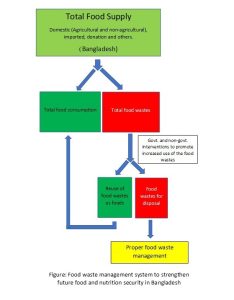
You can read my article that is focusing on this issue (written in Bengali). It was published by the Department of Films and Publications(dfp), Ministry of Information, Bangladesh. I am grateful to them for publishing my article. Please visit the following link to see the article (Page numbers: 23-24).
It would be easy and effective to manage food and nutrition security if you consider the following things for reducing the generation and utilization of food waste:
- People’s ownership, engagement, and participation need to be ensured.
- Proper knowledge regarding food, health, and care needs to be disseminated among general people.
- Practical and appropriate knowledge (religious, social, economic, etc.) also need to be disseminated via different audio-visual aids of learning. It would help us to reduce food waste and increase the use of wasted foods.
- Domestic production of foods may be increased by the utilization of food wastes as fertilizers and alternative foods for poultry, cattle, fish, etc.
- Food storage capacity needs to be expanded as well as made easily available at a lower cost at the individual, government, and non-government levels.
- More research is needed focusing on food storage, preservation, and spoilage as these may reduce food waste generation.
- Food-warning systems and food collaborations between consumers and suppliers of different countries at personal and national levels need to be implemented and refreshed regularly. It would help a lot to regulate the storage, food supply, and circulation of foods-intra and inter-country. It may also help us to address the fluctuation of food supply (excess or low) during natural (e.g., seasonal) and man-made causes (e.g., war). The fluctuation in food supply may cause a huge waste of food if not used or supplied appropriately.
- An individual country should not be dependent on a sole source or supplier of food supply. They should have multiple import and export options to meet the needs.
- Proper implementation of laws and regulations needs to be implemented properly for ensuring food and nutrition security.
- Coordinated management is needed locally, nationally, and globally for the production, import, export, and storage of raw and cook foods, etc. globally.
- …
More…
Inedible Food Wastes: Alternative Uses | Learn Nutrition Online (learnutritiononline.com)
Food Waste | The Nutrition Source | Harvard T.H. Chan School of Public Health
Tackling Food Waste at Home | The Nutrition Source | Harvard T.H. Chan School of Public Health
John C. Trimble: Want to grow healthy food? Start with your lawn | TED Talk
Why Food Waste Remains A Problem
2025 ReFED U.S. Food Waste Report
2025 Wins in Food Waste and What’s Next in 2026
Why is food waste a problem? – The Institute for Environmental Research and Education
Food Waste in America in 2025: Statistics & Facts | RTS
Food loss and waste | Nature Food
*Featured image credit goes to https://www.pexels.com